The ATA AI Test Hackathon
A two day diagnostic run on a live hospital operations platform. No building from scratch — just you, PostQode AI, and a system that's daring you to find where it breaks.
10–12 July 2026 | Remote | Solo or teams of 3
Register Your Team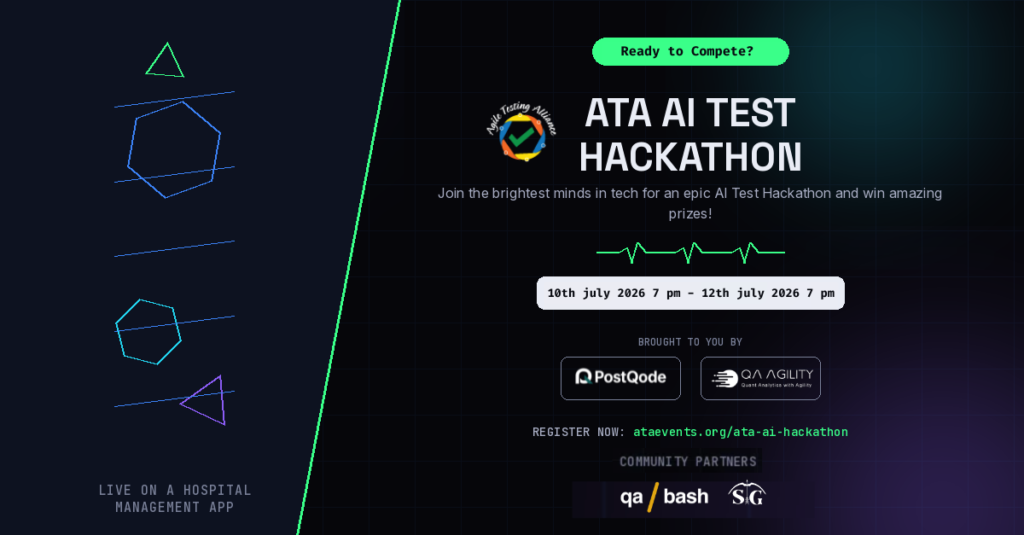
You're not building. You're diagnosing.
Forget the AI chatbot you were going to build over a weekend — that's a different hackathon. This one hands you a real, running piece of software and asks a simpler question: how good are you at breaking things on purpose?
Over three days you'll design a test strategy, hunt boundary conditions most people skip, trace how the system behaves as it moves between states, and push on the API for rules the dashboard never admits to having.
PostQode AI is the only instrument you're allowed to test with — every prompt, every generated case, every automated run happens inside it. Everything else — questions, mentor time, team banter — happens on the ATA Slack.
A live hospital management app
A live hospital operations platform, not a demo sandbox. Every module below writes to the same shared record — which is exactly where interesting bugs like to hide.
Patients get registered, doctors get booked, prescriptions get written, labs get run, wards fill up, bills get paid — and it's all meant to stay in sync on one dashboard. When one corner of the system lies to another, that's your opening.
You would be given access to both Web UI and API.
Where we'd start looking
Patient & appointment flow
Register patients, book, reschedule, and cancel OPD visits — then check what happens when the same patient lands two overlapping appointments with different doctors.
Edge cases
Same-day and back-to-back slot boundaries, near-duplicate patient records, backdated bookings, zero or negative billing amounts, lab reports filed with no doctor or patient attached.
Workflow & state validation
Appointments should only move Confirmed → Completed/Cancelled, labs Pending → Completed, IPD Admitted → Discharged. Try skipping a step, reversing a terminal state, or firing two transitions on one record at once.
Access control
A doctor should see only their own patients; front-desk shouldn't reach billing or IPD data. Then push further — can a lower-privilege user hit a URL or API call directly and get what the interface hides?
Cross-module consistency
Discharge a patient — does the bed free up? Cancel an appointment — does the doctor's slot reopen? Mark a bill paid — does the revenue figure on the dashboard actually move?
API & security
Bad IDs, malformed payloads, oversized fields, special characters in text inputs, and the business rules — billing math, bed limits, prescription logic — that live in the backend, not the UI.
Test strategy & scenarios
Submit a practical test strategy, user stories and Test scenarios and Test cases showing the coverage to user stories. Test Data on how you would test the user stories. Defect reports on defects you uncover and then which story does it tie up to.
Automation solution
Submit working Web UI AND API automation along with execution reports. Covering the test strategy and scenarios.
Defect report
Document every defect with reproducible steps, expected vs. actual results, and severity.
How your submission will be evaluated
Whether you choose the Web UI or API lane, submissions are evaluated on quality, coverage, automation, defect analysis, and overall testing approach—not the number of test cases.
Everything you submit has to be built during the official competition window — no work loaded in beforehand.
PostQode AI must be used for all test design and automation activities.
Talk to each other — the official Slack exists exactly for that.
Questions for organizers, mentors, judges, or sponsors go in the public Slack channels, so the answer helps everyone.
Don't message judges privately about the competition or your evaluation.
Play fair — no copying, interfering with, or disrupting another team's work.
Attempting to attack, exploit, or disrupt the competition platform or related systems is an instant disqualification.
Keep it professional, respectful, and inclusive — the whole way through.
Organizers may update or clarify rules mid-event; any changes go out on Slack.
By participating, you grant Agile Testing Alliance, QAAgility, and PostQode AI permission to use your submitted artifacts, screenshots, recordings, presentations, and related materials for educational, community, and promotional purposes. Your original work will always remain attributed to you.
Prize Details
Competition Launch
Opening session, challenge briefing, platform walkthrough, and official kickoff. Teams receive access to the challenge and the competition timer begins.
Competition Ends
Submission window closes. All test artifacts, automation, defect reports, and supporting documents must be submitted before the deadline for evaluation.
Participation
- Go solo, or as a team of up to 5.
- Solo and team entries are judged against the same criteria.
- Collaboration and knowledge-sharing are encouraged the whole way through.
Official platforms
AI PLATFORMPostQode AI
- Where you actually solve the challenge. A walkthrough and onboarding session runs before the competition begins.
ATA Slack
- Announcements, Q&A, mentor support, and team chatter, for the full length of the event.
Community Partners